Vercel Services: The New Era of Unified Deploy for Full-Stack
Discover how Vercel Services revolutionizes development, allowing front-end, back-end, and multiple frameworks to run in a single project with unified deployment.

Vercel Reinvents Deploy: Running the Full Stack in a Single Project
Vercel, known for its excellence in hosting modern front-end applications, has taken a bold step towards complete development cycle unification. With the launch of Vercel Services in public beta on June 30, 2026, the platform now allows developers to run not only the front-end but also the back-end and supporting services within a single Vercel project. This innovation promises to simplify application architecture and deployment workflows, especially for smaller teams and those using frameworks like Next.js, opening doors for more consolidated project management.
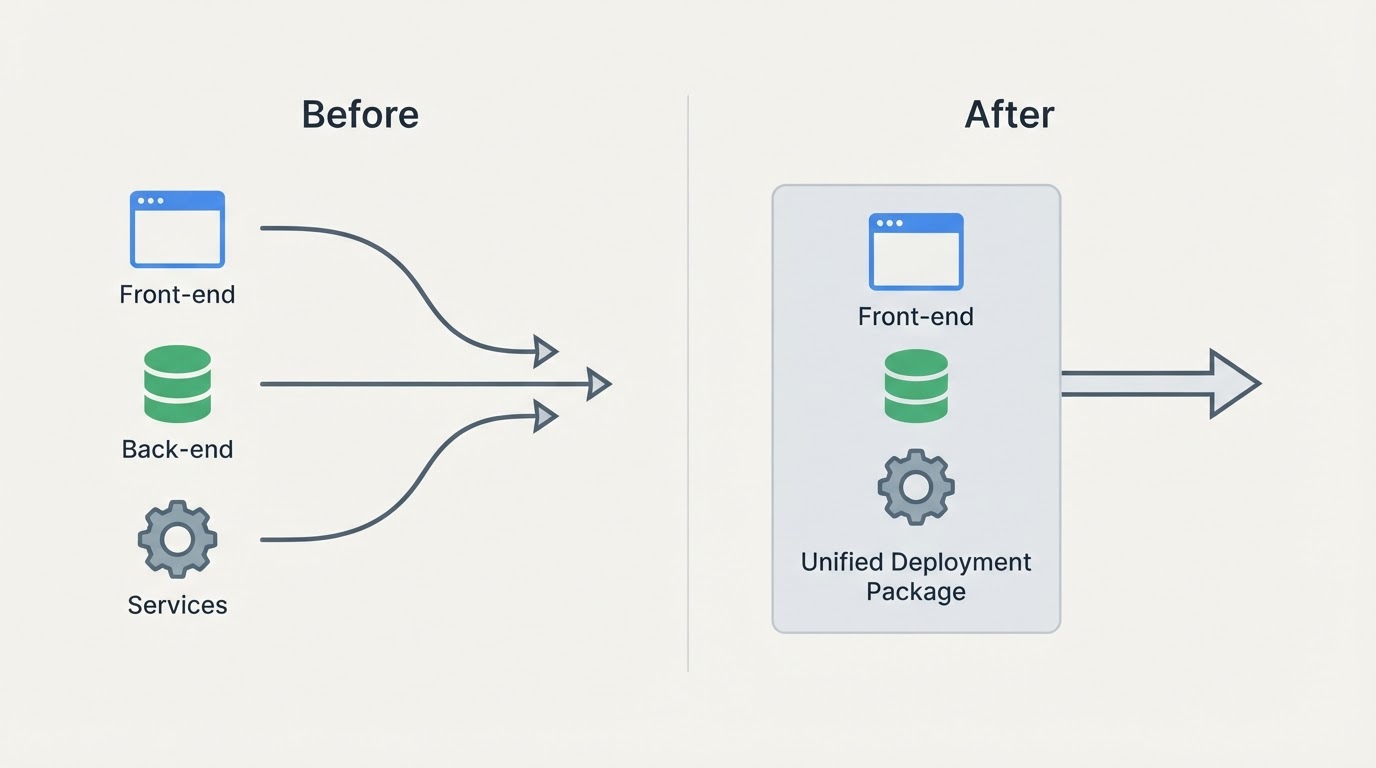
Previously, Vercel was primarily seen as a platform for front-end deployment. Now, with Vercel Services, the vision expands to encompass the entire development stack. This means the front-end, back-end, and other essential services can coexist and be deployed in a unified manner, sharing a single domain. For product teams and full-stack developers, this translates into a more efficient way to structure and manage their applications, reducing complexity and optimizing resources.
Key Highlights:
- Unified Deploy: Front-end, back-end, and supporting services in a single atomic deploy.
- Multi-Framework Support: Flexibility to use Python, TypeScript, Go, Rust, Next.js, Django, and more.
- Private Communication: Services interact internally without exposing traffic to the public internet.
- Automated Infrastructure: Automatic resource detection and provisioning based on the framework.
- Optimized Billing Model: Pay only for code execution time (Active CPU pricing).
What is Vercel Services and How Does It Work?
Vercel Services represents a significant evolution in how web applications are built and deployed. The platform now supports running multiple frameworks and back-ends within a single Vercel project. This means a project can contain, for example, a front-end application in Next.js, an API in Python using FastAPI, and perhaps a processing service in Go, all configured and deployed together. This consolidation simplifies infrastructure management and the developer experience, eliminating the need to manage multiple deployments and separate domains for different parts of an application.
Configuration is managed through a vercel.json file, where a services object is used to declare the root directories for each service, their respective frameworks, and optionally, service bindings. These bindings enable secure, private communication between different services, without data needing to travel over the public internet, which improves security and performance. Vercel supports a wide range of languages and frameworks, including Python (with FastAPI and Flask), TypeScript (with Express and Hono), Go, Rust, Next.js itself for the front-end, and even Django, with automatic CDN detection for static assets.
Why Does This Matter for Full-Stack Developers and Product Teams?
For product teams and full-stack developers, the main advantage of Vercel Services lies in simplification and consolidation. The ability to manage front-end and back-end in a single project, under a single deploy, drastically reduces operational complexity. This translates into faster development cycles, less infrastructure management overhead, and a smoother deployment experience. The concept of atomic deploys is particularly impactful: the front-end, back-end, and any other associated services are deployed or rolled back as a single unit. This ensures all application components are always in sync, minimizing compatibility errors and facilitating maintenance.
Furthermore, shared preview deployments allow any changes, whether in the front-end or back-end, to be previewed in a staging environment before going to production. This is crucial for ensuring the quality and stability of new features. Private internal communication between services is another significant benefit, as it not only enhances security but can also optimize latency, since data doesn't need to leave the Vercel environment for processing. This framework-defined infrastructure approach, with automatic detection and provisioning, alleviates the burden on developers, allowing them to focus more on business logic and less on infrastructure configuration.
Key Features and Benefits in Detail
Atomic Deploys and Shared Previews
The concept of atomic deploys in Vercel Services ensures that when an update is released, all project components (front-end, back-end, etc.) are updated simultaneously. If something goes wrong, the rollback also affects the entire application, returning it to a consistent previous state. This avoids scenarios where an updated front-end expects a back-end version that hasn't been deployed yet, or vice versa. Shared preview deployments extend this benefit, allowing teams to preview the impact of any changes across all services before confirming the production deployment. For more details on Vercel's new deploy features, check out the official changelog.
Private Internal Communication and Security
The capability for private internal communication between services is an important differentiator. Instead of exposing endpoints of one service to the public internet for another service to consume, Vercel allows this communication to occur within the platform's infrastructure. This not only simplifies network configuration but also enhances security, as sensitive data or internal communication endpoints are not publicly exposed. For developers using WebSockets, for example, communication can be more direct and secure. If you're interested in real-time communication features, it might be useful to see how Vercel enables WebSockets in Functions (Public Beta).
Framework-Defined Infrastructure and Auto-Scaling
Vercel Services adopts a framework-defined infrastructure approach. This means the platform can detect the framework used in each service and automatically provision the necessary infrastructure. Whether it's a Python project with FastAPI, a Node.js project with Express, or a Go project, Vercel handles configuring the appropriate compute, networking, and storage resources. All these services run on Fluid Compute, Vercel's compute infrastructure, which offers dynamic auto-scaling to handle load variations. This automation frees developers from the arduous task of managing servers, containers, or complex cloud configurations.
Billing Model: Active CPU Pricing
One of the most practical and attractive aspects for cost management is the billing model. With Active CPU pricing, users pay only for the time their service's code is actively running. This differs from models that charge for allocated server time, even when idle. For applications with traffic spikes or services that run sporadically, this model can represent significant savings. Vercel aims with this approach to align costs directly with the application's actual usage, making pricing fairer and more predictable.
Configuring a Project with Vercel Services
Configuring a multi-service project in Vercel Services is done centrally through the vercel.json file. This file acts as the deploy's brain, defining how each component of your application behaves and interacts.
{
  "services": [
    {
      "src": "/frontend",
      "framework": "next",
      "frameworkConfig": {
        "assetsDir": "public"
      }
    },
    {
      "src": "/api/python",
      "framework": "fastapi",
      "runtime": "python",
      "bindings": {
        "internal_api": "/api/internal"
      }
    },
    {
      "src": "/api/go",
      "framework": "go"
    }
  ]
}
In this example:
- The
/frontenddirectory is configured as a Next.js project, with thepublicfolder for assets. - The
/api/pythondirectory is a FastAPI service running in Python. It defines a binding namedinternal_apithat points to the path/api/internal, allowing other services to call this internal route securely. - The
/api/godirectory is a Go service, where Vercel will automatically detect and configure the environment.
This structure allows a single domain to serve the front-end and expose API endpoints, while communication between back-end services remains private. The rewrites feature in vercel.json can also be used to control public routing, allowing some services to remain strictly internal.
Frequently Asked Questions about Vercel Services
What exactly does "unified deploy" mean?
Unified deploy means that all components of your project – front-end, back-end, APIs, and other supporting services – are deployed and managed as a single entity. This ensures that all parts of your application are always on the same version, preventing compatibility issues and facilitating rollbacks. In Vercel Services, this translates to a single deploy and rollback process for the entire stack.
Can I mix any framework in a single Vercel project?
Yes, Vercel Services supports a wide range of popular frameworks, including Python (FastAPI, Flask), TypeScript (Express, Hono), Go, Rust, Next.js (for front-end), and Django. The platform handles detecting the framework and configuring the necessary infrastructure for each service within your project.
Is communication between services secure?
Yes, communication between services within a Vercel Services project is private and secure. It occurs internally within Vercel's infrastructure, without the need to expose traffic to the public internet. This not only enhances security but can also optimize performance by reducing latency.
How does Vercel Services affect cost?
The Vercel Services billing model is based on Active CPU pricing. This means you pay only for the time your service's code is actively executing. This approach tends to be more economical for applications with variable usage or traffic spikes, as you don't pay for idle infrastructure time.
Conclusion
The launch of Vercel Services marks a turning point for the platform and for full-stack web development. By enabling unified execution of front-end and back-end with multi-framework support, Vercel significantly simplifies application architecture, deployment, and management. For teams seeking efficiency, agility, and an integrated development experience, Vercel Services presents a promising path to optimize their workflows. Consider trying Vercel Services on your next project to consolidate your stack and accelerate your deliveries.

Sobre a Lee Sugano
Lee Sugano
Agência de soluções digitais com base no Japão e clientes em mais de 10 países. Compartilhamos insights sobre desenvolvimento, design e marketing digital para empresas que não aceitam genérico.
Enjoyed this content?
Receive exclusive insights about web development, design, and digital marketing straight to your inbox.
No spam. Unsubscribe anytime.